
Saying goodbye to my last human-designed blog theme
I opened this website sometime in 2018, and have only written 5 blog posts in 7 years. I never imagined I’d be writing frequently, but I gotta admit, I thought I’d hit one blog post per year. I guess the silence in the first six years hasn’t helped with that goal.
As a fun fact, this isn’t even my first home. I started blogging all the way back in 2007, when WordPress was actually something cool and everyone used it. Back then I was a student still and valued time differently, so I blogged pretty often.
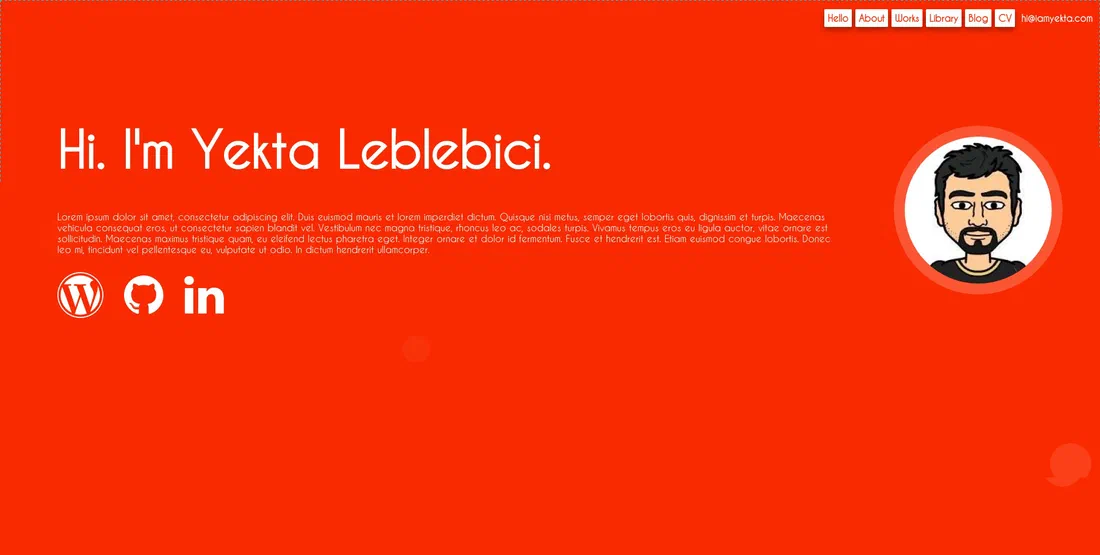
From 2007 to today, my blogs went through multiple redesigns. “You either make a game engine or a game” they say, I wanted to make a blog instead of a blog theme, so I mostly used themes made by other people. Sometimes heavily modifying them, sometimes just playing with the colors and bits and parts.
One thing in common among all of those designs was that they were all made by humans.
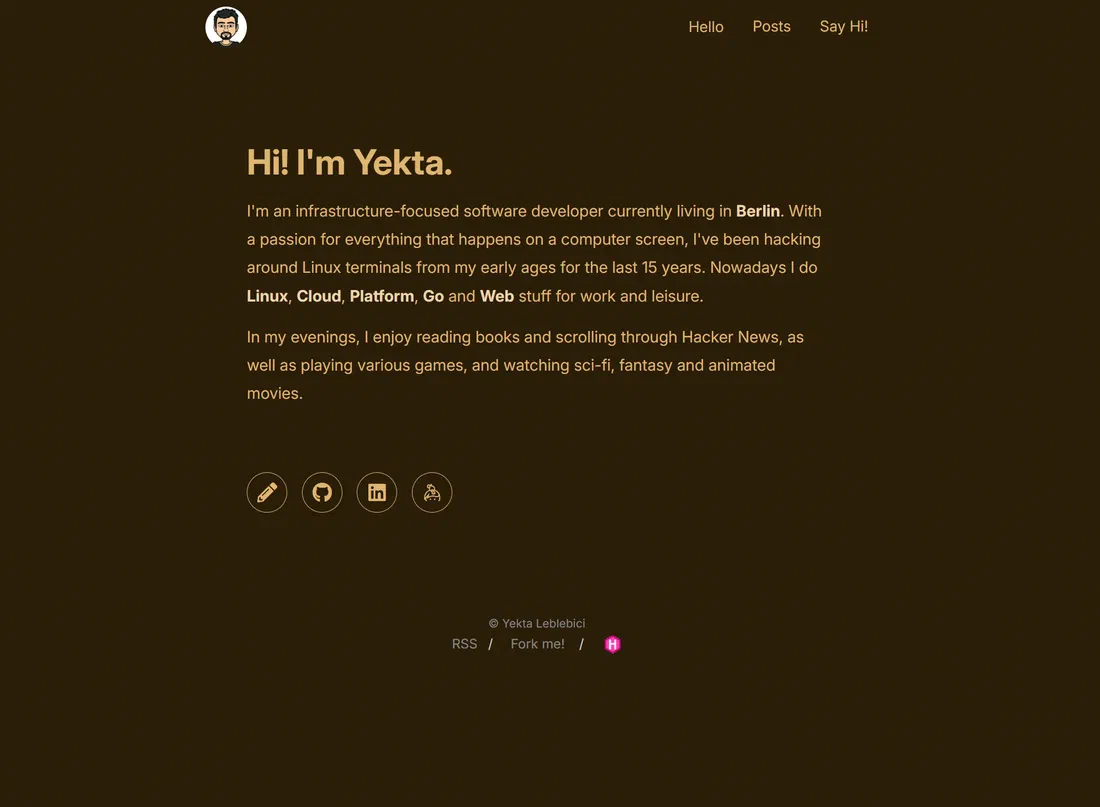
This time something is different. It’s the first time the design is generated by agentic GenAI. Every single line hasn’t been written by a human. In fact none of the lines (other than the ones you’re reading) were written by a human. It’s all written by our friendly AI overlord Opus 4.8, the latest and greatest of the long lineage of Opuses.
Yet I also consider this as an AI and human collaboration. I’ve prompted Claude no less than 58 times until we’ve reached this final design. In this journey we’ve had a terribly gauche 404 page, some of the cringiest widgets ever to be put in HTML, some very questionable color choices and a few other things that might have looked OK to an AI but not so much to those with two organic eyes. Also it one-shotted like 80% of the design correctly. Pareto Principle as a Service.
But is it good? #
Let’s say I have conflicting feelings.
Front and center, I like the new look more. I think it’s cleaner, more readable, more responsive, overall has higher “production value”. It even has some silliness to it, and an easter egg or two are hidden around. Of course it’s all subjective and I haven’t exactly A-B tested it 1 2, but it just looks better to me.
I’m conflicted not because it’s Claude that has written the code and not me, but because of the lossy nature of the process. When I’m on the driver seat, a few pixels of margin here and shadow on the box there are very visible to me, and very fast to iterate on. There’s something magic in hand-writing CSS and messing with the Chrome Developer Tools where the end result tends to be more than the sum of its parts.
When AI is in the driver’s seat, it’s different. It can spit out an entire website in approximately 10 minutes. From a pure wall clock to output perspective, this is unbeatable. It gets a lot of things right, but also some things wrong. Some of the wrong is objectively wrong, while other wrong is just “not what I wanted” kind of wrong. If there’s no prior art, and the specification isn’t very strict, output gets sloppier:
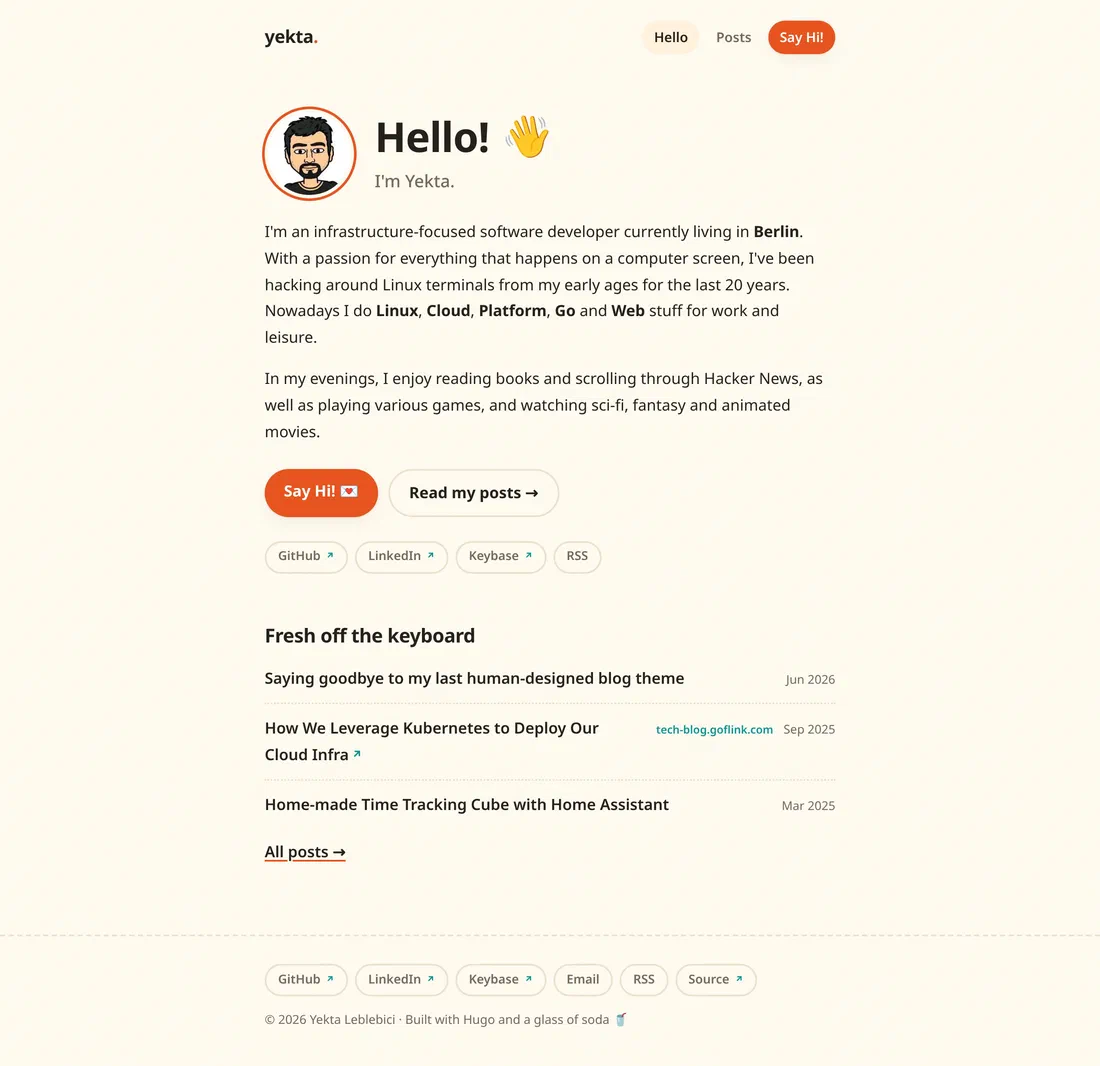
‘No problem’, I say and pull the handle of the slot machine once more. This time I tell it to check my current website. With something to anchor it down, outcome is so much better. Yet there’s something about the low bandwidth communication we have that bugs me. It makes entire designs on its own, but getting it to change something small takes roughly the same time too. Also there are things I can verbalize better, and things that have barely surfaced in my mind, let alone can be put in words. I think that’s what I mean by tactility.
Also the time investment starts running against me. I spend 10 minutes to get an 80% website and another 10 minutes as Claude optimizes the on-hover color of links, and another 5 on some other minutia, shortcoming, disagreement. At some point I have to agree that this design is Claude’s vision, and my input here is to review the work, sand the sharpest edges, and give it a human touch. It can never be what I imagine in my mind, because I don’t have an Export to Figma function for my thoughts. I have to either put in the work and diligently describe every tiny detail of every part of the design with no ambiguity while discovering the ambiguity of my thoughts in this process (which is basically what code is), or accept what comes from Claude filling in the blanks. This is not so dissimilar to using someone else’s theme, this time instead of changing someone else’s already cohesive work and making it mine, we’re working with Claude on finishing up its work to reach a level of cohesiveness.
The experience is like making a painting but you aren’t the one painting yourself, but telling another painter what you want to be painted. Also the painter was born blind. 3 They paint something and they paint well for the most part, but what they paint isn’t exactly what you wanted them to paint. Every detail that was lost in natural language, every assumption made by them, moves the final output from your hands into theirs. Over 58 revisions it is now a good painting, but still in your heart of hearts this isn’t the painting you’d paint.
So…? Is it bad? #
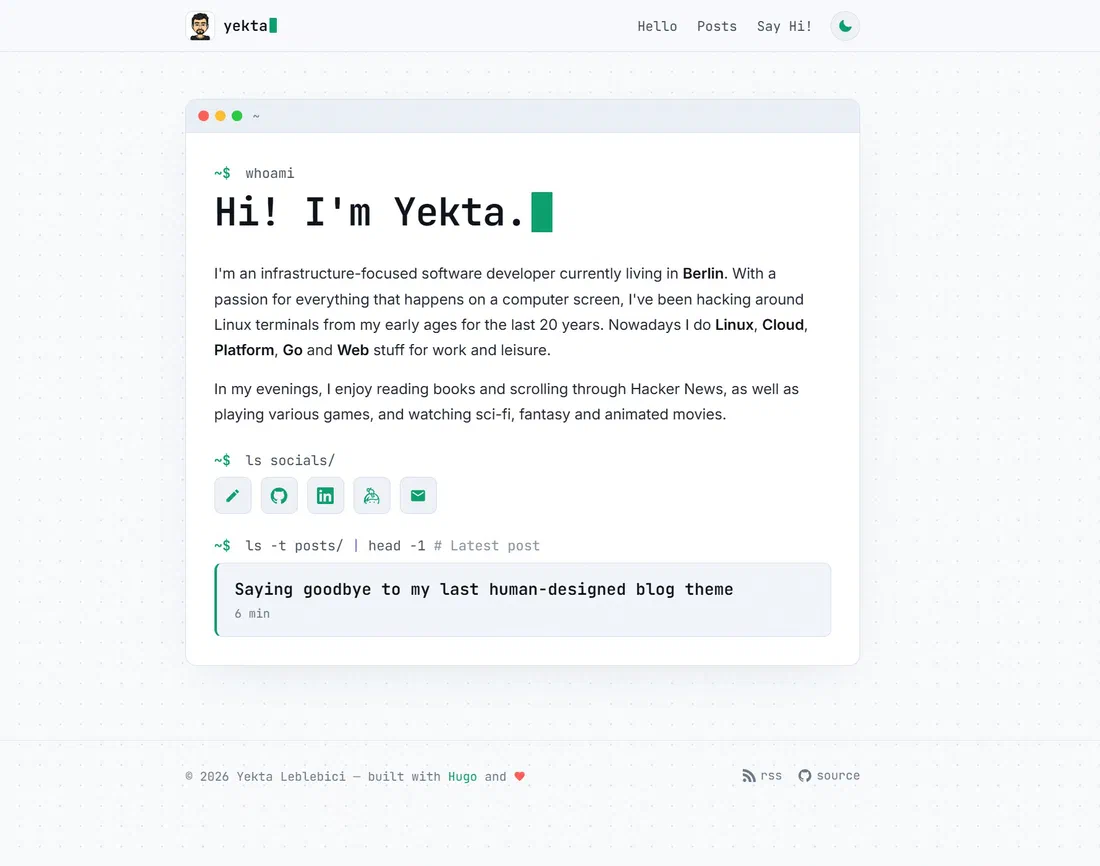
Well, I still like this theme. 
I think it’s an overall improvement over what I had, and I know for a fact that I’m not willing to put in the time to write an artisanal, hand-crafted, 100% Bio organic Hugo theme. I’d rather ramble about AI in that time. Great is the enemy of the good, and I’d much rather have a good theme here than a great one that won’t materialize. I see this line of thought broadly applying to many other problems in the world, and I don’t think that’s something bad. I also think it doesn’t apply to every problem in the world, and one should be wary of the siren song of 10 minute one-shots. My blog looks better now, but also there are so many GREAT and unique ones on Hacker News and this one won’t look as good as them. It also took me more than just 10 minutes.
I still like the theme though.
I asked four of my coworkers and three of them chose this one. One chose the dark version you now get if you click the moon icon. I covered all bases. ↩︎
My wife OTOH didn’t like any of the redesigns and preferred the original look. Perhaps she has a very keen eye for hand-made, artisanal work. ↩︎
Which isn’t itself a blocker for one to become a successful painter. Esref Armagan is one such notable example. ↩︎